Saturday, November 8, 2014

★★★★☆ Gatti is lovely with a French orchestra in Debussy, if the interpretation is lacking

Debussy: La Mer, Prelude to the Afternoon of a Faun, Images
Up to this point I haven't followed Daniele Gatti on disc, but after it was announced he'll be succeeding Mariss Jansons at the Concertgebouw, I felt like I had missed weeks of homework. So I pulled out this Debussy disc of La Mer, Prelude to the Afternoon of a Faun, and Images to give myself a little idea of what to expect in 2016.

Gatti is Italian, but he's working with the French National Orchestra, and there's a strong French tint to this reading. Sony's sound is a bit dry and distant, lending a slight heavy feel, but overall this is a delicate, beautiful La Mer. The tempo is a little slow, but that almost seems to be the point. I prefer interpretations from Karajan, Abbado, Rattle, and Gergiev, and in comparison this reading smacks of sameness, but the sounds are lovely.

It's strange, though, because coming to the Prelude to the Afternoon of a Faun, Gatti chooses a brisk pace that misses opportunity for color. Laziness is actually a good thing in this piece, so I wish for more hazy languor.

Thursday, November 6, 2014

★★★★★ Jansons is searching and galvanizing in the Verdi Requiem--expect things you haven't heard before

Verdi: Requiem
I've surprised myself by becoming a fan of Mariss Jansons, a conductor who was suddenly hit with inspiration with his Bavarian Radio Symphony. There's vitality and sparkling new ideas coming from Germany that we haven't heard in Amsterdam. Irony prevails; I'm glad Jansons is leaving the Concertgebouw instead of the Bavarian Radio Symphony, even though most critics will tell you that the Concertgebouw is the better orchestra.

Jansons is releasing his new Verdi Requiem just over a year after Decca released Barenboim's reading with La Scala, including star soloists Anja Harterost, Elina Garanca, Jonas Kaufmann, and Rene Pape. Jansons' quartet of  Krassimira Stoyanova, Marina Prudenskaja, Saimir Pirgu, and Orlin Anastassov isn't on the same level. Pirgu's Ingemisco is refined and lyrical, a far cry from Kauffman's effusive power.

Tuesday, November 4, 2014

What should the critic be reviewing?

Reviewing who?
Should music critics base their rating on the quality of the composition or the quality of the performance? It's a question that was thrown around a bit on Amazon in chat forums. Anyone who has followed me on Amazon knows that I believe in rating the performance, not the piece, with rare exceptions. Why? Well, when we're reviewing a classic masterpiece down the lines of a Beethoven, Schumann, Tchaikovsky, Bruckner, or Mahler symphony, it's clear that the passing of time has sided with these masterpieces. Must we all adore them? Of course not. We all have personal tastes and preferences, no matter how quirky they may be.

But if I'm going to post a public review, I either keep those preferences hidden or casually state them. I have no qualms telling readers I've gotten tired of the 1812 Overture, any more than I'd rave about my obsession with the Britten War Requiem. But in either case, my rating will be based entirely on the performance. Yet I'm familiar with a handful of reviewers who will give unfavorable ratings to well known works over some quibble about the composition. Frankly, I find such writing useless. I don't need anyone telling me why they don't like the Bartok Second Violin Concerto, for instance. If the reviewer has a personal dislike for the work, just steer clear of it. It's not too different from conductors recording works they don't admire. If you're not in sync with the music, don't try to judge it.

Monday, November 3, 2014

Pianist wants a negative review of one of his performances removed

The Croatian pianist Dejan Lazic is asking the Washington Post to remove a negative review of his 2010 concert at the Kennedy Center. Citing the  EU's "right to be forgotten" ruling, the pianist argues that he should be able to control his own public image. The article is currently at the top of his google search results.

No doubt the pianist feels a bit bummed. But the review was honest, not defamatory in any way. There's no reason for it to be removed. In fact, let's hope it's not, because that would be a slap in the face for free speech.

★★★★★ Yet another great Alpine Symphony, the second one from Welser-Most

Strauss: Eine Alpensinfonie
When is the flood of great new Alpine Symphony recordings going to stop? After years of abuse from critics, Strauss's elusive masterpiece has finally come to the fore. We haven't been lacking in new readings in the new millennium. Before this reading was released I already owned stellar accounts from Thielemann, Harding, and an earlier one from Welser-Most with the Mahler Youth Orchestra. So here Welser-Most is duplicating himself within the same decade, but with good reason. This is an entirely different animal from his earlier reading. And who could turn down yet another reading from the Bavarian Radio Symphony, which plays with such striking virtuosity? And BR Klassik's sound is impeccable, of course.

The opening is aptly mysterious, building naturally, and the Bavarian Radio Symphony plays with more virtuosity than the Gustav Mahler Youth Orchestra. This time around, Welser-Most seems less inward and more propulsive. It's hard to blame him, really, considering how full and magisterial the orchestra sounds. When you add the stellar sonics, this release is bidding to displace Thielemann's reading with the Vienna Phil as the best modern virtuoso version.

It would be wrong to suggest that Welser-Most is simply going through the motions, but this reading isn't as searching or elusive as either his earlier recording or Harding's from earlier this year. He unabashedly aims for thrills, and they're a joy to hear. The warmth of the orchestra is unmistakable. As much as I appreciate other versions, there's a Straussian instinct inherent in the best European orchestras that's hard to replace. The vibrancy from the first desk players is delicious and ravishing in its gentle-hued beauty.

Sunday, November 2, 2014

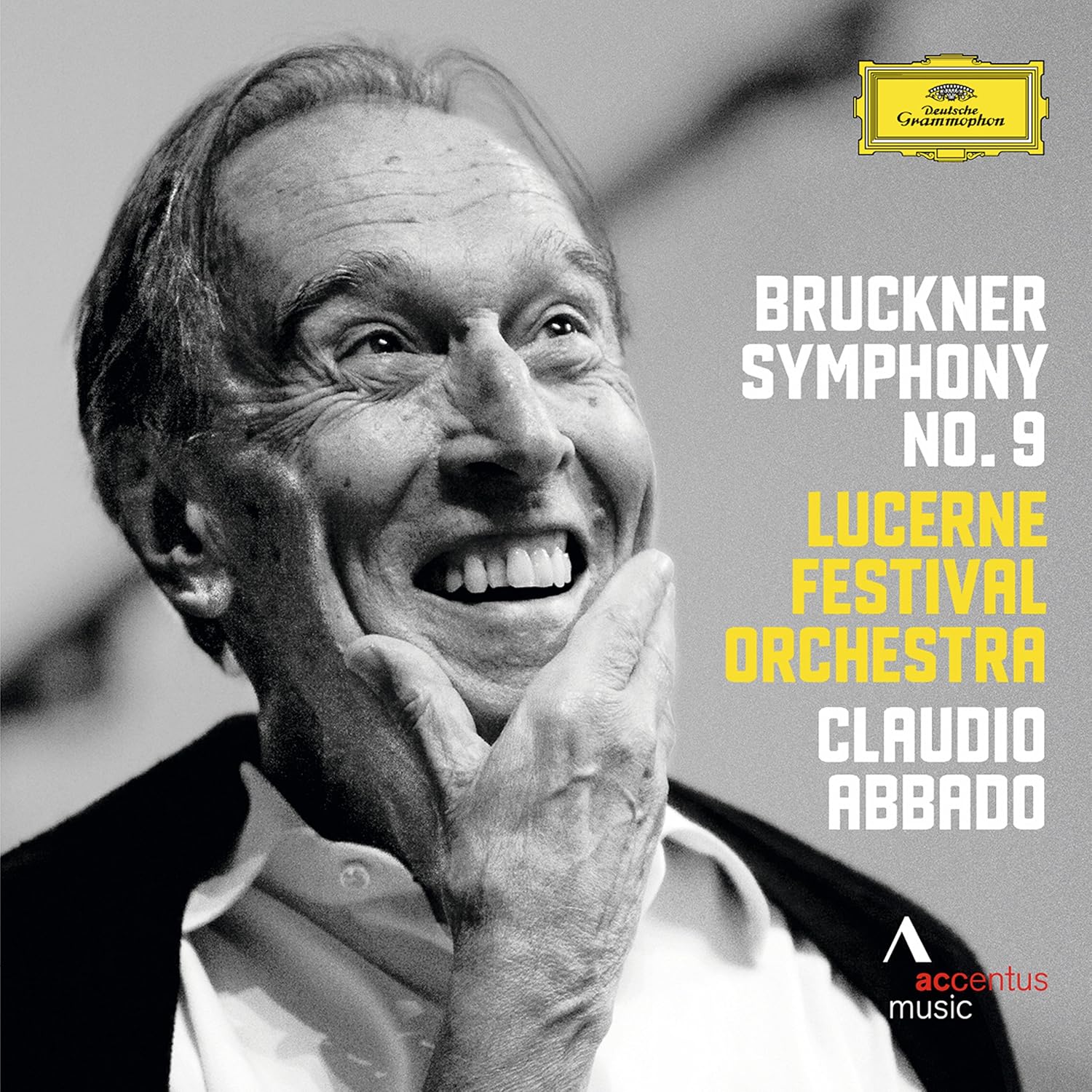
★★★★☆ A moving memorial for a great conductor, though Abbado is subdued and low on intensity

Bruckner: Symphony No. 9
I find myself trembling penning this review, surprised at my own audacity in delivering a critique so soon after our beloved Claudio Abbado passed away. Music lovers universally have mourned the loss of one of our greatest conductors. Despite Abbado's success in Mahler, he seems less suited to Bruckner, despite a generous assortment of discs on DG with the Vienna Phil. Abbado seemed unlikely to gain intensity last minute, given his fragile health, so I didn't expect this Bruckner 9th to truly compete with the best. Nonetheless, I'm too devoted a fan not to give it a listen.

Abbado seems calm and controlled in the opening. He gets a full sound from Lucerne, caught in great sound by DG. Heading into the lyrical second theme, he is fairly subdued and straightforward. This music sounded more passionate under Sir Simon Rattle on his recent recording with the Berlin Phil, and of course Karajan is the perfect exemplar of fire and intensity. Here the strings don't have a real full presence; there's not the sonority in full volume found in the best rival European orchestras. I'd appreciate more impact in the climaxes. But the lyrical passages aren't much better. Abbado has a rare gift of sensitivity that enables him to bring out detail with touching sincerity—I wish I heard that in evidence here. As it is, this first movement sounds like a highly accomplished run-through. The main thing missing is mystery. Abbado is capable of maintaining the line and flow, but he doesn't seem to be searching for anything; at its best, this music is unsettling. The problem isn't so much that he holds back the power in the climaxes as it is that he doesn't find a captivating pulse. It feels smooth, well considered, yes, but not emotionally involving. There's not the rapport between Abbado and the musicians that is indicative of him at his best.

Saturday, November 1, 2014

★★★★☆ 1/2 Finally one of the Russians sounds original in Brahms, if highly unusual

Brahms: Symphonies Nos. 3 and 4
With this final release in his Brahms cycle, Vladimir Jurowski naturally finds himself competing with Valery Gergiev, his elder Russian compatriot also at the head of a major London orchestra. I was disappointed with Gergiev's cycle, which was moderate and resigned with almost no new ideas. Did Jurowski eclipse the more experienced Gergiev, and more importantly, did he prove that the Russians have a legitimate approach to Brahms?

Thanks partly to the clearer sonics, we instantly hear that Jurowski's Brahms is much fresher than Gergiev's. The opening movement of the 3rd Symphony feels alive and warm, and Jurowski voices with compelling impact. It's a tad on the lean side, though; it sounds more modernist than romantic. But it's more moving than I was anticipating. It has a very precise, rhythmic feel, but nothing seems stodgy—Jurowksi is fully involved. Heading into the heart of the movement, Jurowski doesn't try to compete with the heft of the Berlin Phil. He is still fairly lean, but again, surprisingly moving. He's not simply going through the motions, even if he's not outright passionate and far from turbulent. This is comparatively smooth sailing over a land of incredible beauty, realized impeccably. The back and forth between the strings is immaculate. Proceeding into the closing minutes, Jurowski is excitable, but he doesn't try to build to a ringing climax in the way that Karajan and Rattle do. He's entirely stripped of any pretense of nobility. It sounds a bit aloof, but only by a little.