Saturday, November 15, 2014

Is Gatti right for the Concertgebouw?

It's over a month now since the Royal Concertgebouw announced that Daniele Gatti will be succeeding Mariss Jansons as chief conductor in 2016. I'm a fan of the orchestra and I've followed their output with Jansons closely in the past few years, but I was relatively unfamiliar with Gatti when the announcement was made. His discography isn't that big.

I was bit disappointed by the announcement, I must admit. Many listeners will insist that the orchestra itself knows who will suit them best. Perhaps they are right. Any conductor of a great orchestra should be able to generate gorgeous, lovely sounds. Gatti has this capability. But I'm still wondering if he has sufficient energy for the job. Too many great orchestras can become stuck with conductors who know how to produce virtuosic sounds without much interpretation.

Friday, November 14, 2014

Karajan leaves me stunned, again

Just last night I watched the documentary Karajan: The Second Life  on the Berlin Philharmonic's Digital Concert Hall. The film focuses on Karajan's recording life, detailing his habits in the recording studio. I found it fascinating and painful all at once. The incredible greatness and intensity of the man is irresistible, yet he's forever gone and no one since has come close to showing his towering genius.

Thank goodness we have so many recordings, though. His commitment to the highest quality in the studio has enabled his mastery to outlive him. Imagining the discography without him is impossible. He will always have his critics—no genius doesn't—but the overwhelming power and control that he showed at the Berlin Philharmonic is a phenomena we dare not hope to see again.

Thursday, November 13, 2014

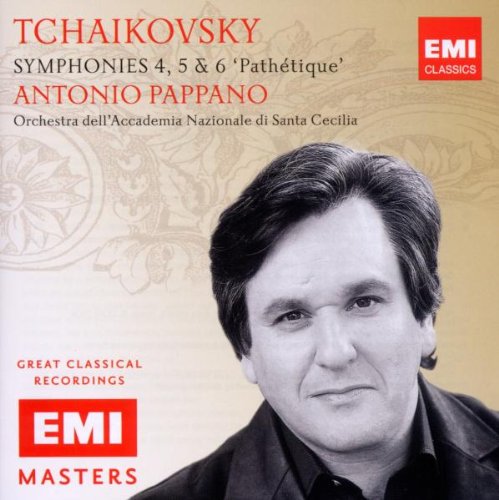
★★★★★ Tchaikovsky from Italy to join the best? Yes, really.

Tchaikovsky: Symphonies Nos. 4 -6
The last three Tchaikovsky symphonies are masterpieces of the highest caliber, but they've been recorded so often that sometimes the listener becomes exhausted. It's no fault of Tchaikovsky's, but the library is crammed full of readings that sound practically the same.

So when a British conductor joins with an obscure Italian orchestra to record these symphonies, it would seem wise to pass by. But Antonio Pappano defies all odds, and this set is ready to be stacked up against the best. His secret is a natural, lyrical flow that builds the drama without wallowing in it. There is a ring of authority to the orchestra's sound that is captivating and hard to resist. But they're playing for beauty, and for once Tchaikovsky is completely stripped of gloom and doom. These are refreshing, exuberant readings.

Wednesday, November 12, 2014

★★☆☆☆ Barenboim is dull and the Berlin Phil sounds dull too, if that is possible

Berlioz: Symphonie Fantasique
Simon Rattle's recording of the Berlioz Symphonie Fantastique with the Berlin Philharmonic had a mixed reception. Critics complained about a lack of drama, a tendency to fuss over details. And there's good reason for the hesitation many record reviewers showed. All the same, I think most listeners agreed that the sound of the orchestra was splendid, and Rattle voiced with astonishing precision; there just wasn't enough interpretive flow.

But what happens when a conductor records a warhorse with a great orchestra and bulls his way through? If you succumb to the curiosity, make a scramble for this CD. Daniel Barenboim simply doesn't have anything to say here. He charges through with no feeling of character, much less suspense or mystery. One couldn't say that there are "problems" with the interpretation; there isn't one to begin with. The Berlin Phil sounds better than your average orchestra, but they've played rapturously for a tepid baton bearer on multiple occcasion. If the Berlin Phil can sound dull, they do here.

Tuesday, November 11, 2014

★★★★☆ Shaham and Boulez pair for a vivid, detailed, Bartok 2nd, but there's a lack of spontaneity

Bartok: Violin Concerto No. 2; Rhapsodies
Pierre Boulez has made a name for himself in Bartok, and Gil Shaham has recorded a glittering array of concerto discs for DG, so it's easy to see why listeners are attracted to this disc. I've just recently come to know the Bartok Second Violin Concerto, and have been amazed at the wealth of inspiration; it has sent me running around, buying half a dozen copies. Surely this disc should be one of them?

This is clearly a beautiful interpretation, one that takes advantage of the sound of the Chicago Symphony, which plays with impeccable polish.  Shaham is assured and golden-toned. This is Bartok played more for elegance than the struggle, for sure, so it sounds a bit smoothed over. Boulez is an accomplished conductor, and there's no denying that he finds a wealth of ideas. But I miss the elements of desperation and agony. The detail and novelty are on a high level, but it doesn't emotionally charge you.

Monday, November 10, 2014

★★★☆☆ Jarvi skates across the surface of the Nutcracker--at least the ice doesn't crack

Tchaikovsky: The Nutcracker
Another Christmas, another Nutcracker, and why not? I've been a fan of Tchaikovsky's ballet since infancy, and repeated exposure has only increased my admiration. I can enjoy the music for its own sake after all these years, but does the prolific Neeme Jarvi have anything new to say in the ballet?

From the start, it's clear Jarvi is taking a balletic approach, not the symphonic one featured on the last major release with Simon Rattle and the Berlin Philharmonic. The Bergen Philharmonic isn't aiming for depth here, or at least Jarvi isn't. He chooses a lean sound and we start out with chipper tempo. Has the March become a racetrack? It might be thrilling momentarily, but it is painfully lacking in substance. There's a wealth of inner drama that develops in Act One that Jarvi rides over with spiritless energy.

And the lightness of the orchestra actually detracts from the nostalgia and festivity.There's a difference between speed and charm, baby. Valery Gergiev took the speed approach in his famous interpretation with the Kirov Orchestra, but at least he has genuine drive. I find Jarvi to smack of glibness, a tendency to interpret the music as if though all the greatness could be assimilated in a quick sight read. And a quick sight read this is, but why cheer?

Sunday, November 9, 2014

★★★★☆ New ideas abound, but can we forgive Fischer for toning down the abandon?

Mahler: Symphony No. 5
Does the rise of new ideas deserve to be applauded? I had to ask myself that question multiple times listening to this Mahler 5th from Ivan Fischer and his Budapest Festival Orchestra. Shifting trends have brought about a stylish new approach to Mahler that is light on emotions in favor of more accuracy and articulation. In general, I'm not a fan of this development. Fischer veers in that direction, but he's a convincing representative. More than anything else, he shows conviction in his conducting, the main thing lacking in much modern Mahler.

So we start off with a funeral march played with more tenderness than passion. The Budapest Festival Orchestra isn't on par with the Berlin or Vienna Phil, but they have a compact, impressive sound. The orchestral landscape is detailed and intriguing, but rather homogenized, so you don't hear individual parts jumping out, even if they're nicely welded together for the whole. This subdued feeling continues into the 2nd movement, where Fischer avoids the scrambling brutality one hears from Abbado and Rattle. This is a nicely judged account, with freshness and new ideas. I can't think of another reading like it. But must it sound so nice? I miss the strings digging into their notes with raw fervor.